Folks, I am shocked.
After years and years of farm animal rescue, animal cruelty education, and legislation to improve living and slaughter conditions for farm animals, Farm Sanctuary organized (and made widely publicized) the National Conference to End Factory Farming.
Since I'm usually not as up to date on national news as I'd like to be, I didn't hear about this conference until last week while half-watching the news. My jaw hit the floor. I was surprised enough to see that national dialogue about factory farming was even taking place, but the real bombshell was the fact that footage taken undercover from factory farms was being shown on the news. With the power of the meat and dairy industries, it would have never seemed possible that this would be shown publicly by a powerful, corporate news source. This was more out than factory farming had ever been.
The conference was held in Arlington, Virginia, starting last Thursday, October 27th, and ended yesterday, October 29th. Sponsored by organizations and companies as varied as Whole Foods, the ASPCA, the Government Accountability Project, PlanetSave, and the Doctors' Prescription for Healthy Living, the goal of the conference was to comprehensively address the negative effects of factory farming, including the public health risks, animal welfare, consumer rights, waste management and climate change, and tips for animal-free living. The diversity of these sponsors and issues shows how many aspects of our daily lives factory farming impacts, from the air we breathe to the water we drink to the food we eat.
These conversations are long overdue, and these issues are becoming harder to ignore. It's not just environmentalists and animal rights activists talking anymore; it's regular consumers, doctors and public health officials. Unfortunately, the US is behind many European nations in the fight against factory farming (the European Union banned the use of antibiotics that could be useful to humans on animals raised for food in 1996 and outlawed all growth-promoting drugs in 2006). As much as regular Americans are beginning to discuss these issues, many are still unwilling to take the steps necessary to combat them. Hopefully, as time goes on, more Americans will involve themselves in these discussions and take action accordingly. We will have to wait and see the outcomes of this conference. Regardless, the existence of the conference itself is a huge step for humans, animals and the environment.
Sunday, October 30, 2011

Thursday, October 13, 2011
You'd Think We Would Get Along...
I hope this doesn't come off as a rant...I really have thought about what I am saying.
I'm reading this book for Advanced Composition (only chunks of it, thankfully) called Animal, Vegetable, Miracle by Barbara Kingsolver. Kingsolver and her family decide to spend a year eating only food they could grow themselves or get from a very local source, with one exception (coffee, tea, chocolate, etc.). That's definitely an extremely respectable goal. Upon picking up this book for class, I was misled into thinking I would enjoy it. And I did, at first. I was swayed into the world of local foods. Granted, I've only made one trip to the farmer's market, but I'm trying. As a college student, it's a bit difficult to make it to a farmer's market on a Saturday morning when you're inevitably at home or hungover or hungover at home.
But then things started to get a little irritating. It started with Kingsolver's daughter, who is my age and majoring in nutrition at college. Firstly, she stated that she only ate 'free-range' meat, which is a completely bullshit label. There is no 'humane' meat--how can slaughtering someone in their adolescence ever be humane? 'Humanely raised' pigs are still slaughtered when they are at twelve years old in human years. Kingsolver Jr. then went on to warn of the dangers of vegans not getting enough vitamin B12 and calcium supplements. Oh, lordy! There's certainly not a store in town that sells those! Except for the fact that they cost less than 10 bucks a month, and are sold virtually anywhere that sells vitamins. Yeah, that's definitely a risk...
I'll ignore the fact that the family slaughters some of their own animals. Better than getting them from somewhere else. But really, if you can look a living, feeling, social creature in the eye and slaughter it completely unnecessarily, that's just...perverse.
Things get worse from there. In chapter 14, which I read through but thankfully do not have to read for class, there is an essential mockery of veganism and arguments that I have heard way too many times. One of the points Kingsolver makes is that vegans think that their lives are completely cruelty-free. Now, I can't speak for everyone, but I don't think most of us are really that thick. Everyone steps on bugs without knowing it. Some people accidentally run over animals with their cars. And every vegan uses something containing animal products sometimes, and most are aware of it. Do you have the patience to ask every restaurant you go to if the datem in their bread is animal-derived? I doubt it. And even if you did, barely ever would anyone in the restaurant know the answer. The worker in the Academic Forum today couldn't even tell me whether or not there was cheese in the roasted vegetables. And yes, animals are killed for the mass production of produce because of the machines involved. But I wouldn't be surprised if many of them were able to get away. And is that really a defense for eating animals? Oh well, you know, animals can die when produce is harvested, so let's kill more. That makes sense.
Another argument Kingsolver uses that I literally rolled my eyes at was the whole "Well, you kill plants!" argument. I literally have not heard that since middle school. Why? Because it's stupid. There is very little, if any, respected scientific proof that plants can feel pain. However, we can know without any tests at all that animals feel pain. They scream, they try to escape, they lose their minds. Pigs can rationalize at the level of a three-year-old child, according to PETA. At the very least, they understand how mirrors work.
What made me the most annoyed, however, was the good old argument that not everyone in the world has the privilege of being vegetarian. Well, no shit. Kingsolver cites people living in mountains and other places where food cannot grow, who must live primarily off of livestock. Therefore, it's not realistic for every vegetarian to expect a vegetarian world (we don't). That's a fine argument, but that's not our society. In fact, it's not even close. In the US, almost everything is available to us in a convenient manner. I'm not saying that this is good or bad, but it's reality. Sure, you can harp on all day about what other cultures do, but your argument's not going to hold water if it's not applicable to our society. Should I then make the argument that, because cannibalism works for other cultures, that it can work for us, even if it's not necessary? Or, more appropriately, that because we have the privilege of having high technology in hospitals, but other countries don't, that we should begin amputating limbs without anesthetics? Sounds unrelated, but is it? Our culture is more technologically advanced than others, and because of this we have more options. People on the plains in Mongolia may only be able to eat cow for dinner, but there's no reason we have to. We have more humane options than that. In our society, there is absolutely no good reason to eat meat. Period.
Expanding on that idea, Kingsolver is always advocating for local food, but since veganism is unrealistic for other cultures, we shouldn't do it. What about our culture? I think in many areas of the country it is far more realistic to live a vegan lifestyle than a local one. Sure, the ideas conflict (we need our tofu, soymilk, etc, which can usually not be bought locally). But that doesn't mean that eating meat in an all-local diet is necessarily better than being vegan. How many people in cities do you think have access to local food? What is more socially sensitive--going over to someone's house for dinner and telling them that you're vegan or that you only eat local and free-range food, which requires explanation? Veganism is realistic for almost anyone in our culture--local food is not. I know that I certainly can't just grow food in my apartment. And someone in a city can't grow all their vegetables in a five square foot yard. But they can follow a vegan diet with little difficulty. And, better yet, why not just encourage people to do their best at both? It's much easier to get close to perfection in a vegan lifestyle than a local one, but one can certainly try. Just eating local meat is still selfish, still cruel--you're still telling something that its life is less important than your taste buds. And let's not forget that people who harp on about family farmed animals--Michael Pollan, for example--still regularly eat factory farmed animals. Most of the time, there's just no easy way to know. And I would much rather take my chances on a minuscule amount of datem than an entire chicken.
One particular quote that has no decent basis was about farm animals: "We breed these creatures for a reason. Such premeditations may be presumed unkind, but without it our gentle domestic beasts in their picturesque shapes, colors, and finely tuned purposes would never have had the distinction of existing," followed by some sentimental quote about Charlotte's Web. Give. Me. A. Break. That's a pretty ignorant statement for someone who works on a farm. Most prominently, it ignores the fact that, no matter how much people like Kingsolver want to idealize, more than 99% of animals are factory farmed. People like her are the exception, not the rule. The rule is cruelty, disease, and death. Let's say that everyone on earth went vegan tomorrow. What would happen to all these animals? Well, let's think about what we would really be losing. Kingsolver is thinking of the animals she raises--real animals. The animals that are raised on factory farms are anything but. They are atrocious Frankensteinian creations who can barely walk because of their sizes and are not meant to live past a few years. They are diseased and are kept alive-barely-by endless antibiotics. They often suffer from horrible disfigurements and many cannot sexually reproduce. If all the factory farms shut down, right now, yes, many would die. But evolution would phase them out. It would be a positive thing--no creature should ever have to suffer that much just by living, and no creature would ever again have to. Even on family farms, it's not as if the animals are living naturally. Cows raised for their milk are constantly impregnated, and that's not a fair life for anyone, especially for the sake of a completely unnatural (for humans, at least), unhealthy and unnecessary product. That milk is meant for their babies. Just as a woman's breasts are relieved when she nurses her child, a cow's udders would be similarly relieved upon her calf drinking her milk.
Lastly, the thread of anthropodenial that runs through the book is just disgusting. The idea that we are so far above animals and that they are not like us in any way is flawed. They were here before us and they will be here after us. Just because they cannot communicate in any of our languages doesn't mean they cannot communicate. As Jonathan Safran Foer says, "If we were to one day encounter a form of life more powerful and intelligent than our own, and it regarded us as we regard animals, what would be our argument against being eaten?" Would we have one? And what would stop that higher species from constantly impregnating women, taking our babies away and then stealing our milk? Or killing us in our adolescence? If nothing can stop us, surely nothing would stop them.
I am not saying anything against local food or against Kingsolver's efforts to be a more responsible consumer. I am trying to make it a bigger part of my life and respect Kingsolver for advocating it. But these arguments are ridiculous, insulting to my intelligence, and overused. And, most importantly, not a single one of them justifies why her and her family eat meat. Because there is no justification. The only realistic one, however silly, is, "It tastes good." I will not be sad to part with this book in the slightest; in fact, I greatly look forward to it. For poetic justice, maybe I'll feed it to a goat.
I'm reading this book for Advanced Composition (only chunks of it, thankfully) called Animal, Vegetable, Miracle by Barbara Kingsolver. Kingsolver and her family decide to spend a year eating only food they could grow themselves or get from a very local source, with one exception (coffee, tea, chocolate, etc.). That's definitely an extremely respectable goal. Upon picking up this book for class, I was misled into thinking I would enjoy it. And I did, at first. I was swayed into the world of local foods. Granted, I've only made one trip to the farmer's market, but I'm trying. As a college student, it's a bit difficult to make it to a farmer's market on a Saturday morning when you're inevitably at home or hungover or hungover at home.
 |
| Not really the time for fresh produce |
But then things started to get a little irritating. It started with Kingsolver's daughter, who is my age and majoring in nutrition at college. Firstly, she stated that she only ate 'free-range' meat, which is a completely bullshit label. There is no 'humane' meat--how can slaughtering someone in their adolescence ever be humane? 'Humanely raised' pigs are still slaughtered when they are at twelve years old in human years. Kingsolver Jr. then went on to warn of the dangers of vegans not getting enough vitamin B12 and calcium supplements. Oh, lordy! There's certainly not a store in town that sells those! Except for the fact that they cost less than 10 bucks a month, and are sold virtually anywhere that sells vitamins. Yeah, that's definitely a risk...
I'll ignore the fact that the family slaughters some of their own animals. Better than getting them from somewhere else. But really, if you can look a living, feeling, social creature in the eye and slaughter it completely unnecessarily, that's just...perverse.
Things get worse from there. In chapter 14, which I read through but thankfully do not have to read for class, there is an essential mockery of veganism and arguments that I have heard way too many times. One of the points Kingsolver makes is that vegans think that their lives are completely cruelty-free. Now, I can't speak for everyone, but I don't think most of us are really that thick. Everyone steps on bugs without knowing it. Some people accidentally run over animals with their cars. And every vegan uses something containing animal products sometimes, and most are aware of it. Do you have the patience to ask every restaurant you go to if the datem in their bread is animal-derived? I doubt it. And even if you did, barely ever would anyone in the restaurant know the answer. The worker in the Academic Forum today couldn't even tell me whether or not there was cheese in the roasted vegetables. And yes, animals are killed for the mass production of produce because of the machines involved. But I wouldn't be surprised if many of them were able to get away. And is that really a defense for eating animals? Oh well, you know, animals can die when produce is harvested, so let's kill more. That makes sense.
 |
| Far superior to veganism |
Another argument Kingsolver uses that I literally rolled my eyes at was the whole "Well, you kill plants!" argument. I literally have not heard that since middle school. Why? Because it's stupid. There is very little, if any, respected scientific proof that plants can feel pain. However, we can know without any tests at all that animals feel pain. They scream, they try to escape, they lose their minds. Pigs can rationalize at the level of a three-year-old child, according to PETA. At the very least, they understand how mirrors work.
What made me the most annoyed, however, was the good old argument that not everyone in the world has the privilege of being vegetarian. Well, no shit. Kingsolver cites people living in mountains and other places where food cannot grow, who must live primarily off of livestock. Therefore, it's not realistic for every vegetarian to expect a vegetarian world (we don't). That's a fine argument, but that's not our society. In fact, it's not even close. In the US, almost everything is available to us in a convenient manner. I'm not saying that this is good or bad, but it's reality. Sure, you can harp on all day about what other cultures do, but your argument's not going to hold water if it's not applicable to our society. Should I then make the argument that, because cannibalism works for other cultures, that it can work for us, even if it's not necessary? Or, more appropriately, that because we have the privilege of having high technology in hospitals, but other countries don't, that we should begin amputating limbs without anesthetics? Sounds unrelated, but is it? Our culture is more technologically advanced than others, and because of this we have more options. People on the plains in Mongolia may only be able to eat cow for dinner, but there's no reason we have to. We have more humane options than that. In our society, there is absolutely no good reason to eat meat. Period.
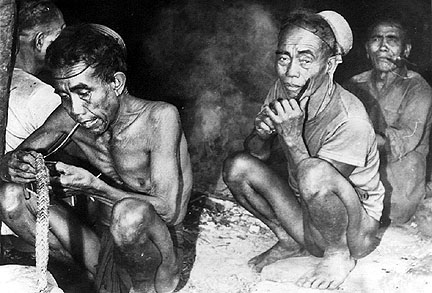 |
| Try a veggie burger, shirtless. They sell those in the Filipino mountains, right? |
Expanding on that idea, Kingsolver is always advocating for local food, but since veganism is unrealistic for other cultures, we shouldn't do it. What about our culture? I think in many areas of the country it is far more realistic to live a vegan lifestyle than a local one. Sure, the ideas conflict (we need our tofu, soymilk, etc, which can usually not be bought locally). But that doesn't mean that eating meat in an all-local diet is necessarily better than being vegan. How many people in cities do you think have access to local food? What is more socially sensitive--going over to someone's house for dinner and telling them that you're vegan or that you only eat local and free-range food, which requires explanation? Veganism is realistic for almost anyone in our culture--local food is not. I know that I certainly can't just grow food in my apartment. And someone in a city can't grow all their vegetables in a five square foot yard. But they can follow a vegan diet with little difficulty. And, better yet, why not just encourage people to do their best at both? It's much easier to get close to perfection in a vegan lifestyle than a local one, but one can certainly try. Just eating local meat is still selfish, still cruel--you're still telling something that its life is less important than your taste buds. And let's not forget that people who harp on about family farmed animals--Michael Pollan, for example--still regularly eat factory farmed animals. Most of the time, there's just no easy way to know. And I would much rather take my chances on a minuscule amount of datem than an entire chicken.
One particular quote that has no decent basis was about farm animals: "We breed these creatures for a reason. Such premeditations may be presumed unkind, but without it our gentle domestic beasts in their picturesque shapes, colors, and finely tuned purposes would never have had the distinction of existing," followed by some sentimental quote about Charlotte's Web. Give. Me. A. Break. That's a pretty ignorant statement for someone who works on a farm. Most prominently, it ignores the fact that, no matter how much people like Kingsolver want to idealize, more than 99% of animals are factory farmed. People like her are the exception, not the rule. The rule is cruelty, disease, and death. Let's say that everyone on earth went vegan tomorrow. What would happen to all these animals? Well, let's think about what we would really be losing. Kingsolver is thinking of the animals she raises--real animals. The animals that are raised on factory farms are anything but. They are atrocious Frankensteinian creations who can barely walk because of their sizes and are not meant to live past a few years. They are diseased and are kept alive-barely-by endless antibiotics. They often suffer from horrible disfigurements and many cannot sexually reproduce. If all the factory farms shut down, right now, yes, many would die. But evolution would phase them out. It would be a positive thing--no creature should ever have to suffer that much just by living, and no creature would ever again have to. Even on family farms, it's not as if the animals are living naturally. Cows raised for their milk are constantly impregnated, and that's not a fair life for anyone, especially for the sake of a completely unnatural (for humans, at least), unhealthy and unnecessary product. That milk is meant for their babies. Just as a woman's breasts are relieved when she nurses her child, a cow's udders would be similarly relieved upon her calf drinking her milk.
 |
| Preeeety sure Wilbur would still exist if he was never turned into bacon... |
Lastly, the thread of anthropodenial that runs through the book is just disgusting. The idea that we are so far above animals and that they are not like us in any way is flawed. They were here before us and they will be here after us. Just because they cannot communicate in any of our languages doesn't mean they cannot communicate. As Jonathan Safran Foer says, "If we were to one day encounter a form of life more powerful and intelligent than our own, and it regarded us as we regard animals, what would be our argument against being eaten?" Would we have one? And what would stop that higher species from constantly impregnating women, taking our babies away and then stealing our milk? Or killing us in our adolescence? If nothing can stop us, surely nothing would stop them.
I am not saying anything against local food or against Kingsolver's efforts to be a more responsible consumer. I am trying to make it a bigger part of my life and respect Kingsolver for advocating it. But these arguments are ridiculous, insulting to my intelligence, and overused. And, most importantly, not a single one of them justifies why her and her family eat meat. Because there is no justification. The only realistic one, however silly, is, "It tastes good." I will not be sad to part with this book in the slightest; in fact, I greatly look forward to it. For poetic justice, maybe I'll feed it to a goat.
Wednesday, October 12, 2011
The Environmentalist Hunter?
A few weeks ago, our Rhetoric class read some speeches and letters of Teddy Roosevelt. In these pieces, Roosevelt expresses his reverence for nature and his love of birds. His presence alone in the anthology American Earth reveals his conservationism. It is also widely known that Roosevelt was an avid hunter. Throughout his lifetime, he hunted and killed numerous bears, geese, rabbits, deer, ducks, buffaloes, skunks, beavers, cougars, and even African animals, such as lions, rhinoceroses, Cape buffaloes, and elephants. This puzzles me...how can one kill what he or she loves? I hear it all the time. "I love animals!," as he or she scarfs down a chicken sandwich.
But what really are the environmental effects of hunting? I can personally find hunting sadistic and unsportsmanlike, but do I have the responsibility to oppose it as an environmentalist?
 |
| Heheheeee... |
Okay, I'm done...let's move on.
The most common argument that I hear from people who support hunting is that it helps to prevent animal overpopulation (I usually hear about deer, an animal that is, perhaps, overpopulating southeastern Pennsylvania). And wouldn't it be better to just shoot them than let them die of starvation? I take two issues with this argument; firstly, the only reason the deer are 'overpopulated' and there's not enough for them to eat is because we use all their land for roads, farms, buildings and shopping centers. What do we expect to happen? We laugh at them and think them stupid for running out into the streets that we put in the middle of their homes. That would be like a track being built through your kitchen with a train that comes through every sixty seconds. And then when you are inevitably flattened by said train, the last words you will hear are "Hahahahaha! Stupid!" Is that fair? Secondly, this argument shows a grave double standard. Children in Africa starve to death every day, but no one suggests shooting them to put them out of their misery. For an even more relevant analogy, dogs and cats suffer from overpopulation as much as deer, and strays starve to death every day, but no one is hunting them. The most we do is spay and neuter our pets (efforts to spay and neuter deer, anyone?). So, even though controlling populations may make sense from an environmental standpoint, it's not really a fair argument.
Even if you take animal rights out of the equation, the facts show that deer hunting is not at all the most effective way to control populations. In fact, it can do the opposite. Typically, more bucks are killed than does, as doe hunting is limited by law. In most areas there are currently eight does to one buck. Since deer are not monogamous, one buck may impregnate many does, and this fact, in combination with the disproportion between males and females, leads to a huge increase in population. And even though hunting can help control populations, this is only immediately after a hunt. The amount of time when there is more food for all the deer is minuscule. A tactic that would really make sense would be to introduce natural predators like wolves into the deer's environments, but that would probably be too 'uncivilized' for most people. However, if we did that and just left the deer alone, their population would be controlled naturally.
What about other animals? Well, we have all heard the stories of species being hunted to extinction or almost to extinction. Of course, the tragedies of these extinctions cannot be denied. Many of the more recently extinct animals (recently being in the last 100-200 years) were killed out greed for fur, hides and skins (the Toolache wallaby and the Quagga), were predators killed mainly by farmers because of perceived threats to their sheep flocks (the Tasmanian tiger and the Falkland Island wolf), because of ridiculous superstitions (the Zanzibar leopard) or, most sickeningly, just for fun (the Passenger pigeon and the Atlas bear). These are the more well-known examples of extinct animals, but few people are aware that 2.7 to 270 species go extinct every day. It is believed that half of the species in the world will be extinct by 2100, and, according to a poll by the American Museum of Natural History, seventy percent of biologists believe that this mass extinction will be catastrophic to human life. The natural world is an intricate web of millions of species of plants, animals and microorganisms that are all connected in some way. When this natural order is disturbed to too great of an extent, the chain of organisms falls apart and humans cannot survive, just as a spider cannot survive if a stick is swung through her web.
Obviously hunting of any animal is not the most significant cause of this eventual mass extinction, but why contribute? Leaving on a light in an empty room, driving a Hummer, or running the water while you brush your teeth aren't the main contributors to global warming, but that doesn't mean you should do them. Punching someone in the face isn't murder, but that doesn't mean you should do it. As with almost all other issues society faces, passivity is the culprit. Hunting without thinking about the implications is irresponsible, as is ignorantly driving an SUV or leaving an unused light on. And that thought process that most people (even you might) have--that "Oh, well it's just one lightbulb, what harm can it do?" mindset--is partially what got us in this environmental hole we're now in. How about a little personal responsibility? The American excuses of fun or convenience are getting old.
Wednesday, October 5, 2011
The #2 of the #2 White Meat
Sorry for the delay, folks! It's been a busy couple of weeks.
Recently, I completed a project for Rhetoric class in which I did a rhetorical analysis of the book Eating Animals by Jonathan Safran Foer. The section of the book I analyzed was entitled "Pieces of Shit," and focused on massive lagoons of pig waste surrounding the factory farms of pork production megacorporation Smithfield. These poisonous lagoons have caused atrocious damages to the surrounding areas and people.
What exactly are these 'lagoons'? What makes them so dangerous? Picture a lake about 3 acres in area, and around 30 feet deep. Now, instead of water, imagine that lake is filled with pig shit. That's a lagoon. And not just shit, mind you, but stillborn and dead piglets, afterbirths, vomit, blood, urine, antibiotic syringes, broken insecticide bottles, hair, pus, and body parts, among any other kind of wastes produced by factory farming (Foer). The pig feces alone contain "ammonia, methane, hydrogen sulfide (think sewage gas), carbon monoxide, cyanide, phosphorus, nitrates and heavy metals." The combined waste hosts over 100 microbial pathogens that can be extremely harmful to humans, like salmonella (Tietz). The worst part is that there can be over a hundred of these lagoons in one place, typically around a slaughterhouse. And when a lagoon becomes too full, the waste either leaks out into the local water supply or is sucked out and sprayed either onto a nearby field or just, you know, into the air (fuck it, why not?).
In 2010, Rolling Stone published an article by Jeff Tietz called "Boss Hog," a piece that revealed Smithfield's practices, including these lagoons and their effects. Tietz tells the following horrific story that illustrates just how dangerous these lagoons are to humans:
"A worker in Michigan, repairing one of the lagoons, was overcome by the smell and fell in. His 15-year-old nephew dived in to save him but was overcome, the worker's cousin went in to save the teenager but was overcome, the worker's older brother dived in to save them but was overcome, and then the worker's father dived in. They all died in pig shit" (Tietz).
Most people that have heard anything about factory farming know of the terrible pollution caused by the industry. What most of us fail to remember, however, is that people actually live near, sometimes almost on, these factories. The suffering of those living in these areas is, in my opinion, the most well-hidden aspect of factory farming. The costs that corporations such as Smithfield externalize onto other people and the environment are enormous. Remember how the lagoons can leak into water supplies? That's not regulated by the government at all, and is perfectly legal. Just as legal is the spraying of shit into the air and onto fields. And that liquified shit finds its way very easily into the lungs of local citizens, who consequently suffer from "persistent nosebleeds, earaches, chronic diarrhea, and burning lungs" (Tietz). In addition, over half the children that grow up on the factories suffer from asthma, while those living nearby are twice as likely to develop asthma (Thicke). People in these surrounding communities have protested and have even managed to pass some laws that restrict this noxious pollution, but because of the power of the industry, the regulations are rarely, if ever, enforced (Foer).
All that mess is on a good day. Imagine if one or more of Smithfield's lagoons flooded or spilled. Oh, wait...it did. In 1995, 20 million gallons of lagoon waste spilled into the New River in North Carolina, a spill twice as large as the 1989 Exxon Valdez oil spill. I couldn't find a picture of the Smithfield spill (which should tell you something), but here's the Exxon spill for reference:
My point is, it's easy for some of us to ignore the unimaginable hell that factory farmed animals go through. But I seriously doubt that most people could ignore these communities, that Michigan worker, his nephew, cousin, brother, and father, with similar ease. And even if we can ignore human suffering, how much of it can we ignore? What about when the lagoons become so full that shit is being sprayed into our backyards, into our lungs and our children's? When will public health win the race against applewood smoked bacon?
Recently, I completed a project for Rhetoric class in which I did a rhetorical analysis of the book Eating Animals by Jonathan Safran Foer. The section of the book I analyzed was entitled "Pieces of Shit," and focused on massive lagoons of pig waste surrounding the factory farms of pork production megacorporation Smithfield. These poisonous lagoons have caused atrocious damages to the surrounding areas and people.
What exactly are these 'lagoons'? What makes them so dangerous? Picture a lake about 3 acres in area, and around 30 feet deep. Now, instead of water, imagine that lake is filled with pig shit. That's a lagoon. And not just shit, mind you, but stillborn and dead piglets, afterbirths, vomit, blood, urine, antibiotic syringes, broken insecticide bottles, hair, pus, and body parts, among any other kind of wastes produced by factory farming (Foer). The pig feces alone contain "ammonia, methane, hydrogen sulfide (think sewage gas), carbon monoxide, cyanide, phosphorus, nitrates and heavy metals." The combined waste hosts over 100 microbial pathogens that can be extremely harmful to humans, like salmonella (Tietz). The worst part is that there can be over a hundred of these lagoons in one place, typically around a slaughterhouse. And when a lagoon becomes too full, the waste either leaks out into the local water supply or is sucked out and sprayed either onto a nearby field or just, you know, into the air (fuck it, why not?).
 |
| Three lagoons next to a pig factory farm |
In 2010, Rolling Stone published an article by Jeff Tietz called "Boss Hog," a piece that revealed Smithfield's practices, including these lagoons and their effects. Tietz tells the following horrific story that illustrates just how dangerous these lagoons are to humans:
"A worker in Michigan, repairing one of the lagoons, was overcome by the smell and fell in. His 15-year-old nephew dived in to save him but was overcome, the worker's cousin went in to save the teenager but was overcome, the worker's older brother dived in to save them but was overcome, and then the worker's father dived in. They all died in pig shit" (Tietz).
Most people that have heard anything about factory farming know of the terrible pollution caused by the industry. What most of us fail to remember, however, is that people actually live near, sometimes almost on, these factories. The suffering of those living in these areas is, in my opinion, the most well-hidden aspect of factory farming. The costs that corporations such as Smithfield externalize onto other people and the environment are enormous. Remember how the lagoons can leak into water supplies? That's not regulated by the government at all, and is perfectly legal. Just as legal is the spraying of shit into the air and onto fields. And that liquified shit finds its way very easily into the lungs of local citizens, who consequently suffer from "persistent nosebleeds, earaches, chronic diarrhea, and burning lungs" (Tietz). In addition, over half the children that grow up on the factories suffer from asthma, while those living nearby are twice as likely to develop asthma (Thicke). People in these surrounding communities have protested and have even managed to pass some laws that restrict this noxious pollution, but because of the power of the industry, the regulations are rarely, if ever, enforced (Foer).
All that mess is on a good day. Imagine if one or more of Smithfield's lagoons flooded or spilled. Oh, wait...it did. In 1995, 20 million gallons of lagoon waste spilled into the New River in North Carolina, a spill twice as large as the 1989 Exxon Valdez oil spill. I couldn't find a picture of the Smithfield spill (which should tell you something), but here's the Exxon spill for reference:
 |
| Remember, this is half the size of the Smithfield spill |
Subscribe to:
Posts (Atom)