I hope this doesn't come off as a rant...I really have thought about what I am saying.
I'm reading this book for Advanced Composition (only chunks of it, thankfully) called
Animal, Vegetable, Miracle by Barbara Kingsolver. Kingsolver and her family decide to spend a year eating only food they could grow themselves or get from a very local source, with one exception (coffee, tea, chocolate, etc.). That's definitely an extremely respectable goal. Upon picking up this book for class, I was misled into thinking I would enjoy it. And I did, at first. I was swayed into the world of local foods. Granted, I've only made one trip to the farmer's market, but I'm trying. As a college student, it's a bit difficult to make it to a farmer's market on a Saturday morning when you're inevitably at home or hungover or hungover at home.
 |
| Not really the time for fresh produce |
But then things started to get a little irritating. It started with Kingsolver's daughter, who is my age and majoring in nutrition at college. Firstly, she stated that she only ate 'free-range' meat, which is a completely bullshit label. There is no 'humane' meat--how can slaughtering someone in their adolescence ever be humane? 'Humanely raised' pigs are still slaughtered when they are at twelve years old in human years. Kingsolver Jr. then went on to warn of the dangers of vegans not getting enough vitamin B12 and calcium supplements. Oh, lordy! There's certainly not a store in town that sells
those! Except for the fact that they cost less than 10 bucks a month, and are sold virtually anywhere that sells vitamins. Yeah, that's definitely a risk...
I'll ignore the fact that the family slaughters some of their own animals. Better than getting them from somewhere else. But really, if you can look a living, feeling, social creature in the eye and slaughter it completely unnecessarily, that's just...perverse.
Things get worse from there. In chapter 14, which I read through but thankfully do not have to read for class, there is an essential mockery of veganism and arguments that I have heard way too many times. One of the points Kingsolver makes is that vegans think that their lives are completely cruelty-free. Now, I can't speak for everyone, but I don't think most of us are really that thick. Everyone steps on bugs without knowing it. Some people accidentally run over animals with their cars. And every vegan uses something containing animal products sometimes, and most are aware of it. Do you have the patience to ask every restaurant you go to if the datem in their bread is animal-derived? I doubt it. And even if you did, barely ever would anyone in the restaurant know the answer. The worker in the Academic Forum today couldn't even tell me whether or not there was cheese in the roasted vegetables. And yes, animals are killed for the mass production of produce because of the machines involved. But I wouldn't be surprised if many of them were able to get away. And is that really a defense for eating animals? Oh well, you know, animals can die when produce is harvested, so let's kill more. That makes sense.
 |
| Far superior to veganism |
Another argument Kingsolver uses that I literally rolled my eyes at was the whole "Well, you kill plants!" argument. I literally have not heard that since middle school. Why? Because it's stupid. There is very little, if any, respected scientific proof that plants can feel pain. However, we can know without any tests at all that animals feel pain. They scream, they try to escape, they lose their minds. Pigs can rationalize at the level of a three-year-old child, according to PETA. At the very least, they understand how
mirrors work.
What made me the most annoyed, however, was the good old argument that not everyone in the world has the privilege of being vegetarian. Well,
no shit. Kingsolver cites people living in mountains and other places where food cannot grow, who must live primarily off of livestock. Therefore, it's not realistic for every vegetarian to expect a vegetarian world (we don't). That's a fine argument, but that's not our society. In fact, it's not even close. In the US, almost everything is available to us in a convenient manner. I'm not saying that this is good or bad, but it's reality. Sure, you can harp on all day about what other cultures do, but your argument's not going to hold water if it's not applicable to our society. Should I then make the argument that, because cannibalism works for other cultures, that it can work for us, even if it's not necessary? Or, more appropriately, that because we have the privilege of having high technology in hospitals, but other countries don't, that we should begin amputating limbs without anesthetics? Sounds unrelated, but is it? Our culture is more technologically advanced than others, and because of this we have more options. People on the plains in Mongolia may only be able to eat cow for dinner, but there's no reason we have to. We have more humane options than that. In our society, there is absolutely no good reason to eat meat. Period.
 |
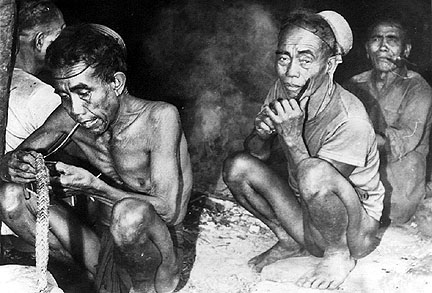
| Try a veggie burger, shirtless. They sell those in the Filipino mountains, right? |
Expanding on that idea, Kingsolver is always advocating for local food, but since veganism is unrealistic for other cultures, we shouldn't do it. What about our culture? I think in many areas of the country it is
far more realistic to live a vegan lifestyle than a local one. Sure, the ideas conflict (we need our tofu, soymilk, etc, which can usually not be bought locally). But that doesn't mean that eating meat in an all-local diet is necessarily better than being vegan. How many people in cities do you think have access to local food? What is more socially sensitive--going over to someone's house for dinner and telling them that you're vegan or that you only eat local and free-range food, which requires explanation? Veganism is realistic for almost anyone in our culture--local food is not. I know that I certainly can't just grow food in my apartment. And someone in a city can't grow all their vegetables in a five square foot yard. But they can follow a vegan diet with little difficulty. And, better yet, why not just encourage people to do their best at both? It's much easier to get close to perfection in a vegan lifestyle than a local one, but one can certainly try. Just eating local meat is still selfish, still cruel--you're still telling something that its life is less important than your taste buds. And let's not forget that people who harp on about family farmed animals--Michael Pollan, for example--still regularly eat factory farmed animals. Most of the time, there's just no easy way to know. And I would much rather take my chances on a minuscule amount of datem than an entire chicken.
One particular quote that has no decent basis was about farm animals: "We breed these creatures for a reason. Such premeditations may be presumed unkind, but without it our gentle domestic beasts in their picturesque shapes, colors, and finely tuned purposes would never have had the distinction of existing," followed by some sentimental quote about
Charlotte's Web. Give. Me. A. Break. That's a pretty ignorant statement for someone who works on a farm. Most prominently, it ignores the fact that, no matter how much people like Kingsolver want to idealize, more than 99% of animals are factory farmed. People like her are the exception, not the rule. The rule is cruelty, disease, and death. Let's say that everyone on earth went vegan tomorrow. What would happen to all these animals? Well, let's think about what we would
really be losing. Kingsolver is thinking of the animals she raises--real animals. The animals that are raised on factory farms are anything but. They are atrocious Frankensteinian creations who can barely walk because of their sizes and are not meant to live past a few years. They are diseased and are kept alive-barely-by endless antibiotics. They often suffer from horrible disfigurements and many cannot sexually reproduce. If all the factory farms shut down, right now, yes, many would die. But evolution would phase them out. It would be a positive thing--no creature should ever have to suffer that much just by living, and no creature would ever again have to. Even on family farms, it's not as if the animals are living naturally. Cows raised for their milk are constantly impregnated, and that's not a fair life for anyone, especially for the sake of a completely unnatural (for humans, at least), unhealthy and unnecessary product. That milk is meant for their babies. Just as a woman's breasts are relieved when she nurses her child, a cow's udders would be similarly relieved upon her calf drinking her milk.
 |
| Preeeety sure Wilbur would still exist if he was never turned into bacon... |
Lastly, the thread of anthropodenial that runs through the book is just disgusting. The idea that we are so far above animals and that they are not like us in any way is flawed. They were here before us and they will be here after us. Just because they cannot communicate in any of our languages doesn't mean they cannot communicate. As Jonathan Safran Foer says, "If we were to one day encounter a form of life more powerful and intelligent than our own, and it regarded us as we regard animals, what would be our argument against being eaten?" Would we have one? And what would stop that higher species from constantly impregnating women, taking our babies away and then stealing our milk? Or killing us in our adolescence? If nothing can stop us, surely nothing would stop them.
I am not saying anything against local food or against Kingsolver's efforts to be a more responsible consumer. I am trying to make it a bigger part of my life and respect Kingsolver for advocating it. But these arguments are ridiculous, insulting to my intelligence, and overused. And, most importantly, not a single one of them justifies why her and her family eat meat. Because there is no justification. The only realistic one, however silly, is, "It tastes good." I will not be sad to part with this book in the slightest; in fact, I greatly look forward to it. For poetic justice, maybe I'll feed it to a goat.