Recently, there's been an increasing amount of talk about "in vitro meat." "Eating babies?" you might ask. No, of course not.
 |
| Not your recent order at Chick-fil-a |
So, what does in vitro meat mean for the environment?
While many people understand that animals are literally physically and psychologically tortured during the meat production process, fewer understand the environmental effects of factory farming. This extreme style of farming takes a toll on almost every aspect of our environment. It takes about 2,500 gallons of water (that's half of the water consumed in the US!) and 16 pounds of grain to produce one pound of beef. According to a report by Britain's Food and Agricultural Organisation, raising livestock contributes 18% of the world's greenhouse gasses to the atmosphere, which includes the production of fertilizer, clearing land, producing the meat, transporting it, burning of or fumes from animal waste, and, animals, ahem...breaking wind. Meat production contributes more greenhouse gasses to the atmosphere than all forms of transport in the world combined.
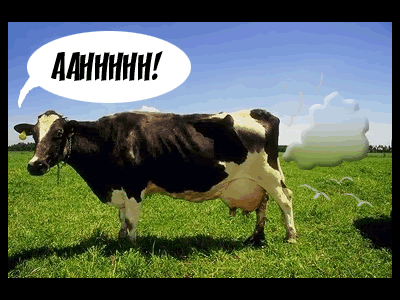 |
| The face (well....you know) of global warming |
Through in vitro meat, we could essentially avoid most, if not all, of these environmental problems and emissions associated with meat production, which would greatly, greatly reduce the amount of greenhouse gasses being emitted into the atmosphere. As of right now, the only problems with in vitro meat are removing certain antibiotics from it (which are found in nearly all forms of meat anyway) and cost. Because of the methods of production used by factory farming, the price of meat only increased, in some cases, twenty cents from 1980 to 2004, with no meat increasing more than two dollars over that period of time. Competing with these prices will be difficult for producers of in vitro meat, not to mention competing with multi-billion dollar meat production corporations, who have far more influence over the government and the market than any scientist. Hopefully, however, these challenges will be able to be met and a "humane" meat will finally be available for all.
Before I go, I'd like to reference a viral e-mail from a few years ago. The claims of this e-mail have been proven to be false, but it makes an excellent point about the issue of in vitro meat:
"During the space race back in the 1960's, NASA was faced with a major problem. The astronaut needed a pen that would write in the vacuum of space. NASA went to work. At a cost of $1.5 million, they developed the 'Astronaut Pen.' The Russians were faced with the same dilemma. They used a pencil" (www.snopes.com).My point here is, why spend millions of dollars developing a better non-essential food item? I completely support in vitro meat and what it is attempting to do, but no one needs to eat meat in our developed world. There are only one or two vitamins unobtainable from a plant source, and they are readily available in multiple supplements and vitamins. I understand that it is unrealistic to expect everyone to go vegan, but it is certainly a much simpler solution. And if there's anything our modern world could use once in a while, it's simplicity.

No comments:
Post a Comment